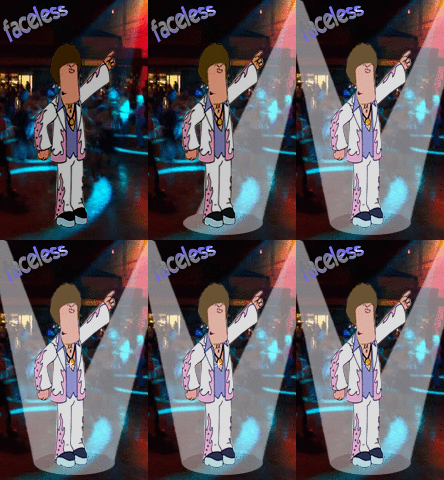

Comedian and TV presenter Adam Hills reveals a picture of his protege, Adam Vincent.
Hills' hoist
Stephanie Bunbury
February 15, 2009
theage.com.au[/align]
ADAM Hills had his Big Idea when watching Adam Vincent, a lesser-known comedian he had befriended on the English comedy trail, in a show at last year's Melbourne International Comedy Festival. "He was performing to 30 people," says Hills, "and he would have known seven of them personally. And this was the most genuine, raw stand-up at the festival: no artifice, no bells and whistles, done not from the heart, but from the gut. It was honest and brave. And I walked away thinking there should be more than 30 people in that room. He should have a bigger venue and a publicist behind him."
Someone who knew the traps, someone who had been through the mill, should get that happening. Someone like him, in fact. And here is the end result of that thought: Dick the Horse, Hills' new production company, which has its official launch today. Under its auspices, Hills is producing solo shows by three comedians — Vincent, Hannah Gadsby and Jesse Griffin, who performs as a country-warblin' dude called Wilson Dixon — for the comedy festival.
The newest of this bunch to the scene is Hannah Gadsby, who has only been performing for three years. She came into the Hills orbit when they sat next to each other on the flight to Montreal Comedy Festival last year and, as she tells it, played Playstation golf all the way. "I was very nervous about sitting next to him for so long and I think I dribbled shit for about 24 hours," she says. "But apparently he was impressed and thought, 'I'll put money behind that shit'."
Actually, says Hills, what impressed him was that at the end of that gruelling flight, when they were both practically delirious with tiredness, Gadsby was told she was on in a couple of hours. "And in eight minutes, she stormed it." After that, he says, agents kept giving her business cards — "she didn't schmooze or talk herself up in bars; people were just drawn to her" — but she didn't know what to do with them.
True enough, Gadsby says. "I'm not very good on personal administration. If Adam hadn't taken me on, I probably wouldn't have registered for the festival in time; I'm not a go-getter. That's half my charm, I suppose, but it's not very helpful. I've let myself down over the years; lots of times I've never had a job above entry level. In fact, I've never had a job interview — but it makes you work harder when someone has belief in you."
Jesse Griffin first met Hills at a benefit show for firefighters in Adelaide eight years ago, did Spicks and Specks with Hills in the interim then came on as an ad hoc act in a rowdy late-night show Hills was running a couple of years ago at the Edinburgh Fringe Festival. "The previous two acts were booed off," he said. "Then Jesse came on and after 10 minutes had a standing ovation." The trick, says Griffin, is to be quiet. "What I do is really slow, not big or loud or full of double entendres. A lot of people get shouted down in Late'n'Live. I just pluck my guitar for a while; nobody knows what's going on, so they want to listen to find out. I like that, that he's an unusual character, this quiet country guy."
The problem with the Melbourne comedy festival for local performers is almost the opposite of running Edinburgh's gauntlet of jeering drunks: they can simply get lost in the shadows. "It's hard for people who aren't on TV or who don't have a pedigree like Rod Quantock's," says Griffin, a New Zealander who used to be part of a sketch group called The Four Noels.
"There is a kind of conflict in that it is an open festival, but the festival produces the overseas performers and gives its own acts the best times and locations. At the same time, having the overseas acts gives the festival the profile it has, so that is just the way it is. I don't mind any more and there's nothing I can do about it. I'm just grateful Adam has done what he's done."
Dick the Horse will organise venues and publicity for the acts in the new stable, recovering costs from the various box offices, Griffin explains. "But mostly, it's like having a celebrity endorsement."
There is no ostensible common thread between the three acts on the Dick the Horse slate, unless you count the fact that both Vincent and Gadsby have hazy formative memories of early Bill Cosby routines. But, says Adam Vincent, comedians are defined as much by what they don't talk about as what they do. None of the three relies on shouting. Vincent is from Adelaide; he worked in Britain in 2004-05. "Then, when I came here, I started being yelly to get noticed," he says. "I was desperate, loud and in your face. But it wasn't sitting right. For me, comedy is peeling back your onion and seeing what's there. I'm the theme: I'm a man and here is my struggle in the world." He has certainly stopped yelling; silence, he says, is the comedian's best friend. "Silence and vulnerability are the keys to comedy."
That need to be honest, even merciless, with oneself is something Gadsby would recognise. Her main subject is her mother, she says matter-of-factly; Freud would have a field day with her. Does she mind? "Yes. She does NOT like it. She came to see me and got frightfully drunk because she was nervous and proceeded to heckle. Then she turned round to the laughing audience and yelled, 'Don't encourage her!' "
Gadsby had never seen a live comedy act until she was persuaded to enter Raw Comedy three years ago and, incredibly, won it. "If I'd known what I know now, I would never have done it," she says. "But I was 27 and I think I spent years honing my act without knowing it at dinner parties; I pulled out things I'd used as ice-breakers and I picked up on themes I still talk about. Like my mother. And I come from a really horrible town in Tasmania. Everyone loves laughing at small towns they don't have to live in."
Griffin, by contrast, has developed his country rocker persona with such conviction that even Americans believe him when he announces he comes from Cripple Creek. His humour is both sharply literate and dust dry; any Flight of the Conchords fan would recognise a kindred spirit, even if he or she didn't realise he was actually from New Zealand.
"From time to time I've wanted to try being me on stage, but I don't know what I'd do. I think it would take a year or two's journey on stage to find out who I am on stage, but two kids and Wilson take up a lot of time."
Besides, he finds the constraints of the Wilson Dixon character bracing. "Working in a narrow band forces you to be creative. Can you have a glass, spoon and a piece of string and make a show? Yes you can! That idea underpins my work and my life in general, really: that idea of not wasting things, about not having a lot of stuff. There's something about Wilson's world I like: something about space, the rural nature of it, that he's a bit isolated. I'm thinking of log cabins and slightly decaying things, cars on blocks in the yard. It's a unique perspective."
Of course, all these comedians share one important attribute: Adam Hills thinks they are funny. His new initiative reflects the fact that comedians, for all that they compete with each other on the circuit, are also a kind of fraternity who cheer each other more loudly than anyone else and commiserate with each other when the crowds won't play ball.
"No one did this for me," says Hills. "But there were always older comedians to talk you down when you were having a bad time; Greg Fleet did that for me."
He's prepared to watch their shows and make suggestions and bounce ideas around; at the same time, he's determined to get them making flyers. By this stage, he's sounding like one of the mother hen managers who abound in comedy. "I'm more excited about this," he says, "than I am about my own show."
