[align=center]
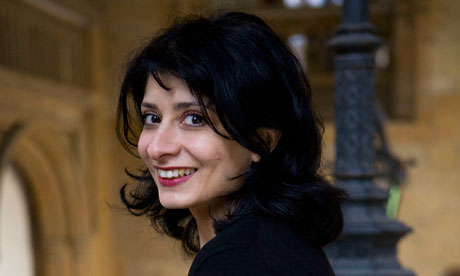
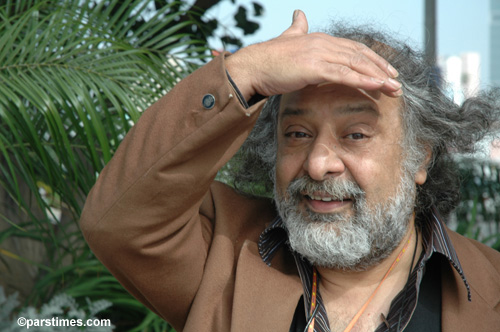 Relative values: Shappi Khorsandi and her father, Hadi Khorsandi
Beverley D’Silva
Relative values: Shappi Khorsandi and her father, Hadi Khorsandi
Beverley D’Silva
timesonline.co.uk
July 26, 2009 [/align]
HADI: We came to England from Tehran in 1977, 18 months before the revolution in Iran began. In Iran I had been a satirical columnist for a national daily newspaper and for women’s magazines. I wrote three articles against the key figures of the revolution. They were not hard articles, but the regime didn’t like any criticism. They want everybody to obey, and I couldn’t. There was a big demonstration against me. They wanted to kill me — not officially, but in the street a knife comes to your stomach and your throat. I went underground, and eventually we left the country. In a taxi from Heathrow we passed through Ealing Common, and I smelt the grass and I smelt freedom.
Shappi was born in Iran, and was 3½ when we came here. I took my kids to the nursery and I said to the teacher: “My daughter is half past three, and my son is half past four.” I was very proud of expressing my English. In London I published my own satirical paper against the regime. Nobody spoke against the regime then; I was the first.
I wasn’t a politician or hardliner. I never attacked religion, only the superstitious side of religion. I was, and am, an artist-writer, a liberal social-democrat poet. The regime didn’t like my newspaper, and they tried to rub me out. But with the intelligence of Scotland Yard, who received information of a plot to assassinate me, I’m still here. They arranged for us to stay in a bed and breakfast in Eton. I told Shappi and her brother, Peyvand, that we were going on holiday. They said: “On a Wednesday? And what are those policemen doing here?” But we were okay and things settled down.
The first job Shappi did was impersonating Mrs Thatcher for us. She was seven. She’d say: “We shoot Irish rebels with plastic bullets; we don’t kill them, we just make them crazy.” I don’t know where she got the idea from. Not from me. I learnt from her, though, when she went to the stand-up-comedy teacher — how the first part of the show should be longer than the second, and a microphone is a must, even if the audience is only two people, because it’s stand-up comedy, not theatre.
Shappi was very selfish as a child, as she is now. I think she was an anarchist as well. She got through in her way of not caring about anyone or anything, and when she decided to do something, she did it. If we said: “Why don’t you do your homework?” she would shout at us: “Why don’t you do yours? Your English-speaking embarrasses me.” She and her brother taught me about racism, feminism, and human rights over here. They helped me to integrate into the Western culture.
When Shappi was a student, I used to give her a little vodka and caviar because I wanted to demystify alcohol, so that if she goes with a man and drinks, she can control herself. She, in turn, the first time she did a stand-up show at the Edinburgh Festival, banned me from the city. I think she doesn’t like to be criticised, full-stop. I didn’t mind that she was a woman doing stand-up because I am a feminist. I feel I may become a lesbian soon.
Now she is married, and I like my son-in-law and have sympathy with him — I know how difficult it is living with Shappi. After all, I did it for 25 years. I’m worried about their life, Shappi being in showbiz and having a child, and I’m advising her to do less. I say: “Be careful. There’s your high life on stage, yet at home there is one person waiting for you. Look after that one more than the crowd.”
And so now I am a grandfather, and after 45 years of being a writer I have ended up being the babysitter for another writer. I enjoy this job.
It helped me give up the cigarettes, even my shot of whisky. Once she was daughter of Hadi Khorsandi; now I am father of Shappi. I’m glad to be her father. She is more quick than me. I like that she is writing: literature is more valuable than showbiz. If she does another book I’ll be happy because stand-up is something that goes in the air. But a book can go next to Shakespeare.
I’m sad I cannot go back to Iran. I am sad for the people there because life is tough. We didn’t like the shah, who was in power when we left, but what is happening now is far worse. When this lot came to power they lied and said there would be freedom, that women could be free in their appearance. But they were killing the people. They kill journalists and bloggers.
For 30 years this volcano has been waiting to erupt. Now that it has, the people are fighting back against tyranny. I can’t march with them in Tehran, but I protest with them through my writing. The regime tried to shut its youth off from the world, but the internet has shown them they are not alone. I do miss my mother country, but when I leave England I get homesick for London; the years I’ve been here are equal to the ones
I spent there. My life here has more adventures. I feel safe, too: there are many now that speak against the regime. The only thing that will kill me now is my cholesterol level.
SHAPPI: When I was little, my dad was always going out the door in a suit and aftershave, and always coming back with people. He was the hub of the Iranian community — writers, politicians in exile would come. At home we spoke Farsi, and there would be heated debates, arms would be flapping, voices raised. And Dad was always the centre of attention. I remember watching him being so funny and fabulous, and feeling I would burst with pride and love.
My parents had endless parties that went on till all hours, any day of the week. During one of them, the police came round in response to a complaint. I have pictures of these policemen in my parents’ flat — they were doing Iranian dancing. Dad’s infectious. He’s a people person. But it could be hard to get his attention; I sometimes wanted to shove them all out, and go: “Hello, it’s me!”
For Dad, everything revolved around his work. He wrote through the night. I didn’t read his writing then — I still don’t, though it’s wonderfully accessible and I know some of his poems by heart. When he wrote, he was quiet and peaceful. Otherwise he was manic. A tornado. He’d come in at 4am with a tray of breakfast, saying: “Eat up, get in the car, we’re going to Brighton.” An hour later we’d be visiting friends there. He’s so spontaneous.
Being with Dad was always great fun, and funny. He has an element of slapstick. Nothing would be out of bounds. One day the whole family had a yoghurt fight. We were flicking it at each other, and everything — us, the carpet, pot plants — was covered in yoghurt. We were bent over laughing. He had instigated it all. Of course, my mum had to clean it all up. She is the unsung hero.
I started doing impressions when I was seven, first impersonating my father, then my mother. Then I did Margaret Thatcher impressions. At the parties I’d perform for everyone. My brother would be Martyn Lewis, interviewing me. My father would hush everyone up to listen. He’d be very proud when I made the grown-ups laugh. I once asked him: “Would you rather I became a doctor or an actress?” He said: “An actress.” You’d win his approval and praise if you got people to watch you or you made them laugh. Getting people to notice you became a measure of how good you were as a person.
Dad was more concerned with our thinking than academic success. He introduced me to Charlie Chaplin, and we’d have discussions about him and socialism and the underdog. He had a way of making you see that people are equal. A pharmacist friend of the family had drugs for field hospitals during the war. I was nine, and I said: “Are you making sure the medicine is going to Iranians not Iraqis?” And Dad said: “Does it make a difference?”
When the revolution happened in Iran, there was a darker side to our lives. My uncle was shot dead by the shah’s police when he was out demonstrating. He was 19. Countless numbers of my dad’s colleagues were executed, jailed and tortured. Then the Iran-Iraq war happened, and all our family was in Iran. But Dad made a huge effort to hide the bad stuff from us.
Even before we got the news that there was a plot to assassinate my dad [in 1984], people were warning him not to play with the regime. He was such a threat because he was so popular. At the time I wanted him to stop writing and making the ayatollah angry. I thought he was selfish; I didn’t understand why he was putting our lives at risk. Five years ago, Dad had a heart attack, and needed bypass surgery. We said: “Even if he dies, at least they didn’t get him.” Seeing him to a natural death would be a victory over the regime. He says he can’t go back to Iran, that London is his home now. I’d love to go there, but if I went, they could keep me there, and I might not see my son for months, or they could pinpoint jokes I’ve done about the mullahs.
My dad can meet somebody and know straight away what makes them tick. He’s a force of nature. He’s a phenomenal chess player. And he’s very good at maths, too — and joke-telling is a mathematical skill. I’ve never seen anyone create the pathos on stage that he can.
I went to see him on stage in Los Angeles, and I saw how he weaves stories into his act, and then in the last 10 minutes it was all machinegun-fire jokes. I thought: “I can’t compete with that.”
When I had my first boyfriend, at 15, I couldn’t tell my mum, but I could tell my dad. He was my ally. I know he thinks I don’t like being criticised. But he’s never had a bad review. He performs to the Iranian diaspora who know him and love him — not in pubs and clubs for strangers, like me. I’ll never have the universal love he has. But
I think he’s glad I perform for a mainstream British audience, rather than being marginalised.
At first there was pressure from him on me to do political material and to be a satirist. It was: “I can’t believe you’re doing trite topics like relationships.” Now he’s proud I’ve found my voice. He’s wise. I was writing a book, doing stand-up and I had a new-born baby. It was proper mental. Dad said it was okay to slow down. He’s kept me sane.
Neither of us likes being told what to do, and we both have a temper. But when it comes to the bigger issues and seeing the good in people, we’re on the same page.