[align=center]
 Rab's return
He’s off the booze and Mary Doll has her own cleaning business in a cracking Christmas special Gregor Fisher returns as Rab C Nesbitt for a one-off Christmas special
Rab's return
He’s off the booze and Mary Doll has her own cleaning business in a cracking Christmas special Gregor Fisher returns as Rab C Nesbitt for a one-off Christmas special[/align]
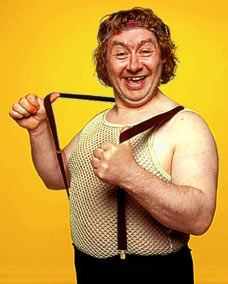
In the dark of a Glasgow cinema, nine years are reduced to an interruption as a familiar, dishevelled figure veers into view. His hair is washed, but still unkempt in a grimy headband; his jacket is new, but still rumpled over a string vest; his face is older and unshaven, teetering between a scowl and blank incomprehension. His voice is unmistakable. Time has wrought subtle changes on Rab C Nesbitt but his essential nature, the irascibility and acute sense of persecution, defy revision.
This is the first time he has appeared on screen since 1999. We are attending a special preview of his forthcoming Christmas special. Within the opening moments, Nesbitt is berating a security guard and railing against his own misfortune. Eating ice creams in the cinema’s back row, the principal cast and crew are tight with anxiety. How would the audience, after nearly a decade of his absence, respond to Nesbitt?
“It got a good reaction,” says Ian Pattison, the show’s writer and creator, in a hesitant voice. “But that’s only anecdotal. We gave it a good shot. We sweated to make it. When it’s on the television, I’ll be watching from behind the couch.”
The return of Rab C Nesbitt — in what, for now, is a one-off programme, is a big cultural event in Scottish terms. He first appeared in the sketch show Naked Video in 1986, with the opening episode of his own sitcom being aired over Christmas 1988. Within two years it was being broadcast across the UK and, at its height, it attracted 6m viewers. Nesbitt seemed a product of his time, encapsulating the unemployment and disaffection of 1980s and 1990s Scotland. Govan, where he lived, was a place of closed-down shipyards and heavy drinking, and Nesbitt, an out-of-work alcoholic who presided over a dysfunctional family, was pitilessly shaped by his surroundings.
He became a national icon, with one of his string vests displayed in the People’s Palace, Glasgow’s museum of social history. He even featured in a Time magazine article on Scotland. But Govan is a different place now: many of the tenements have been refurbished and the BBC and STV have moved into the area, which is being marketed as a “digital media village”. Wine Alley, where the Nesbitts were supposed to live, is boarded up. Comedy, too, has evolved in the intervening years. So is Nesbitt still relevant?
“He is a universal, common-man creation, while all the world is happening around him,” says Gregor Fisher, the actor who brings Nesbitt’s inherent rage to life. “That might have been Margaret Thatcher, it might now be the one-eyed son of the manse or the global financial meltdown. He reacts to what the world throws at him. He’s got interesting and, hopefully, funny things to say about his situation, whether in the 1990s or 2008.”
Fisher went on to enjoy a career as a fine character actor post-Rab. He appeared in films such as Love Actually and The Merchant of Venice and played Grandpa Potts in the stage version of Chitty Chitty Bang Bang. He exudes a graceful patience, comfortable, it seems, to re-engage with a character he felt compelled to cast aside nine years ago. After eight series, four television specials and a stage show, this accomplished actor had grown weary of playing Nesbitt, and he phoned each of the cast members personally to explain his decision to walk away.
There were rumours of tensions among the actors, in particular between Fisher and Tony Roper, who played Jamesie Cotter. The cast and crew also had to cope with the arrest and imprisonment in 1993 of Eric Cullen, who played one of Nesbitt’s two sons, for possessing child pornography. Cullen, whose character was known as “Wee Burney”, had been sexually abused as a child and attracted considerable sympathy. He died three years after his spell in jail, from a heart attack.
“It makes it much more interesting when people say there was tension,” Fisher says obliquely. “There was the tension that comes from working very hard. It’s not necessarily a huge fireworks display of friction, but everybody in their own way is trying to do their best work. There’s this myth that it all ended in disaster, but not as far as I’m concerned. It ended because it was time to do something else. I don’t make any apologies for that.”
Whatever the strains, Fisher and Roper were prepared to revive their characters for a stage show two years ago. From those initial discussions, the concept of a one-off TV special began to take shape. Colin Gilbert, the programme’s director and producer, had long been keen to resurrect the show, but Pattison needed time and space to allow the idea to take on a more amenable form.
Like Fisher, Pattison earned enough from Rab C Nesbitt to provide a comfortable financial existence. Both men felt the irony in discussing the show’s return over an expensive lunch. It was watching TV coverage of the Glasgow airport terrorist attack 18 months ago, while working in Budapest, that refocused Pattison’s mind on Nesbitt and his life.
“I thought, ‘Rab will have a take on that. I wonder what it would be?’ That was the portal into opening his world up to me. Then it was a case of thinking how he and the other characters would have moved on. The challenge was how to make him relevant to today. If I didn’t feel I could do that, I wouldn’t have got back into the arena again.”
So Nesbitt has sworn off alcohol and now chairs a temperance group, having discovered religion. Mary Doll, his long-suffering wife, played by Elaine C Smith, runs a cleaning business with her friend, Ella Cotter. Gash, the Nesbitts’ eldest son, is married and has become a vegetarian. Only Jamesie Cotter remains defiantly unreconstructed, apart from the hooded tracksuit top and gold earring he now wears. “For somebody his age from Govan, it’s a massive leap,” Roper says of the jewellery. “It would have convinced him he was utterly attractive to any woman — mistakenly, of course.”
Roper admits to reservations about reviving Cotter on screen rather than on the stage, because he was worried about trying to look the same age as the rest of the cast — at 67, he is 14 years older than Fisher and 17 years older than Smith. Once back in character, however, and with his white hair dyed, his scepticism diminished and he gleefully admits that he and Fisher often disrupted filming by laughing helplessly during scenes.
In the intervening years, Smith has been reluctant to return to her role as Rab’s wife. When the show ended, she was invited to casting sessions in London after the programme’s success, only for the producers to be dismayed when she turned up with long, dark hair, rather than Mary Doll’s blonde wig.
She is pleased about the way Pattison has moved the characters on. “It was wonderful to see the development of Mary and that she and Ella would get up off their backsides and run a cleaning company,” she says. “But I always felt the characters were ahead of their time and that was why there was such a resistance to them in certain elements of Scottish society. That always used to annoy me, because there was a part of Glasgow society in particular that wanted to pretend that Nesbitt didn’t exist.
“I look at the Royle Family, for instance, and that’s the Nesbitts’ living room. I look at The Simpsons, and that’s the Nesbitts. But it’s that classic thing in Scotland where we sneer at our own. I don’t think it was like that among viewers, but it was among the so-called cognoscenti.”
The forthcoming programme was shot over seven days in and around Glasgow — and Pattison, who was on set for the first time ever, was struck by the actors’ familiarity with the roles, the way they immediately fell back into the voices and characterisations. Fisher once complained that the iconic string vest he wears became a torment as it chafed his nipples during the filming of outdoor scenes, but he has no regrets about returning to the role, he says.
Fisher famously rejected the idea of playing Nesbitt when Pattison first approached him for a Naked Radio sketch in the mid-1980s, fearing that it was a one-dimensional and trite condemnation of the west of Scotland drunken male stereotype. It was only when he read the script and recognised “what happens between the lines, where he comes from, what he’s about”, that he changed his mind. Nesbitt’s character had enough depth to be redeemable, despite his pugnacity.
The show evolved to deal with such bleakly dark topics as devil worship, cannibalism, contract killings on homeless people, incest, sexual harassment and neo-Nazis, but always leavening the grimness with a sharp humour. The Christmas Special remains blithely unconcerned with political correctness — anal sex is among recurring gags — but there is also sentimental affection.
Fisher and Roper cautiously welcome the prospect of Rab C Nesbitt returning for a more prolonged run, while Pattison is more circumspect. All three are quick to say no decision can be made until the audience figures and reviews for the Christmas Special are known.
But Rab C Nesbitt is back, and already it feels like he never left us.
Rab C Nesbitt Christmas Special, Tuesday, December 23, 9pm, BBC2
---------------------

 [/align]


