
Portugal: Massive Protest Against Troika Sparks Momentum
Sara Moreira
7 September 2012[/align]
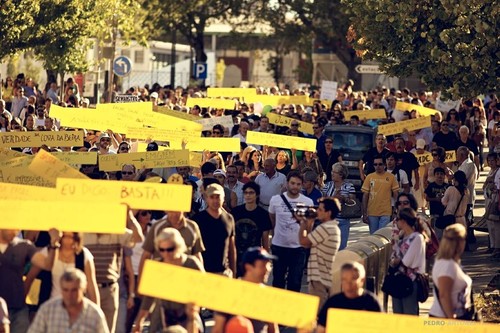
Since the period that followed the end of dictatorship in Portugal in 1974, there hasn't been such wide participation in a protest [en] as September 15's massive anti-austerity mobilization ‘Screw the troika! We want our lives‘ (Que se lixe a troika! Queremos as nossas vidas) [en]. Between 660,000 and 1 million people of all ages took to the streets in more than 40 cities throughout the country and abroad, booing the government, the troika [of inspectors from the European Commission, the European Central Bank and the International Monetary Fund], the inequity, the growing unemployment and impoverishment and the lack of justice and opportunities for all.
Social networks have been abuzz, with the hashtags #15sPT and #QueSeLixeATroika still being used on Twitter. The blog O que diz a rua (What the street says) gathers a vast set of crowdsourced photos and videos of the protests that are used to illustrate this post.
The challenge is the day after
The figures show how an increasing proportion of the population of this country of roughly 10 million is discontented with the measures imposed by the government and the troika to address the public debt. On September 7, Prime Minister Pedro Passos Coelho had announced more austerity measures to be implemented in 2013, which will visibly worsen the impact of debt in the pockets and accounts of both public and private workers.
Whereas the scale of the protests is a sound and clear sign that people reject those measures, the coming weeks are expected to bring more developments in the political arena, with President Cavaco Silva having called a State Council meeting next Friday, September 21, while the state budget for 2013 is expected to be voted on in parliament on October 15.
Meanwhile, citizens are using their blogs to reflect on the momentum that the protests have brought, and writing about possible paths for strengthening citizenship. “Instead of complaining about politics, it is time for us to do it”, writes journalist Daniel Oliveira, on his blog for Expresso newspaper.
Looking for inspiration on how citizens have “intervened in society and started demanding more democratic participation” following the economic crisis in Iceland in 2008, groups are organizing screenings of a recently launched documentary Pots, Pans and Other Solutions (Global Voices reported on the preparation of the documentary in September 2011, Portuguese ask Icelanders about democracy):
Professor Heitor Alvelos from the University of Porto, believes that the real “challenge is the next day”. He argues that “the demand of a new country involves the reinvention of the paradigms of social relations”, and writes about lessons learned from the aftermath of March 12's Scrapping-by Generation [en] protests, saying that one should neither “start making proposals” nor “organizing movements”:The payment of bank debts by citizens went to referendum. The government was forced to create a Council to write a new constitution: a citizens’ group - without politicians, lawyers or university professors – who opened the discussion process to everybody and managed to approve by consensus a draft proposal. In Iceland, many citizens are now organized in associations and have substantial proposals for a society where everyone can participate.
"The beginning of an effective change should start as simply as from an invitation for everyone to start going to the streets -every- Saturday, without an agenda, only to re-invent the public space (geographical, social and affective) in an intuitive and generative way, infinitely multiple. Talking with strangers, amplifying micro-debate, finding similarities, differences, bridges, obstacles, contrasts and conciliation. Nurturing in the long term a living, active, self-regenerating social tissue."
--------------------
If the figures quoted are right that's about 10% of population